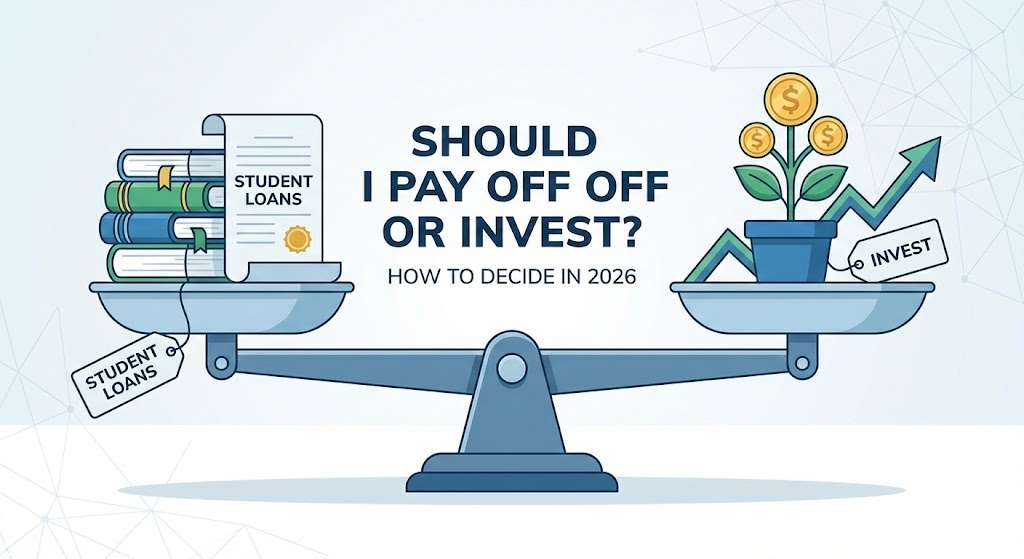
The Bottom Line: In 2026, choosing between student loan payoff and investing depends on your interest rate relative to the 6% threshold. If your loans are above 6%, the guaranteed return of payoff is your mathematical priority. If your loans are below 4%, the opportunity cost of not investing is high, as market compounding typically outperforms low-interest debt over the long term.
The Math of Opportunity Cost: The 6% Rule
From a mathematical perspective, every dollar put toward a student loan is a dollar that cannot be invested in the market. We use the 6% framework to guide this decision. Paying off a loan with a 7% interest rate is equivalent to earning a guaranteed, risk-free 7% return on your money—something the stock market cannot guarantee in any single year.
Conversely, if your federal student loans are at 3% or 4%, the opportunity cost of paying them off early is high. Historically, diversified index funds return 7%–10% annually over long horizons. By investing instead of overpaying low-interest debt, you are capturing the “spread” to increase your future net worth.
Visualize Your Student Wealth Path
Don’t guess with your financial future. Use our specialized tool to model your IRS tax deductions and 2026 inflation adjustments.
Run the Student Loan SimulatorEstablishing Your Foundation: The Emergency Fund
Before allocating extra cash to debt or investments, you must secure your financial safety net. We prioritize an emergency fund covering 3–6 months of living expenses. As noted by the Consumer Financial Protection Bureau (CFPB), having this cushion ensures that a surprise expense won’t force you into high-interest credit card debt, which is far more damaging than student loans.
Debt Avalanche vs. Debt Snowball
If the math favors repayment (rates above 6%), you need an efficient strategy. According to StudentAid.gov, understanding your loan types is crucial.
- Debt Avalanche: Mathematically superior. You target the loan with the highest interest rate first, minimizing your total interest paid.
- Debt Snowball: Psychologically focused. You pay off the smallest balances first to build momentum, even if it costs more in interest long-term.
Frequently Asked Questions
Should I invest while I still have student loans?
Yes, especially if your employer offers a 401k match. An employer match is effectively a 100% return, which mathematically outperforms any student loan payoff strategy.
Is it better to pay off loans during economic volatility?
If your interest rates are very low (below 4%), staying invested in high-quality assets often remains the superior long-term strategy, even during volatility. However, debt reduction can provide peace of mind for risk-averse borrowers.
Are student loan interest payments tax-deductible?
In the US, you may be able to deduct up to $2,500 of student loan interest from your taxable income. This lowers your effective interest rate, making investing even more attractive for low-rate loans. Our simulator handles these phase-outs automatically.
Advanced Financial Modeling:
- Universal Strategy: Compare any debt type in our Wealth Builder Simulator.
- Mortgage Decisions: Analyze low-rate housing debt: The 3% Mortgage Advantage.
- Inflation Mechanics: See how r ≈ i − π affects your real balance: Inflation Impact Explained.